News
What is the Role of AI in Chemical Safety Management? Let's Hear What They Say
The 12th Symposium on Risk Control and Hazard Treatment in Chemical Industry Held in Tianjin, hosted by the China Chemical Safety Association, was held in Tianjin on November 19. At the parallel session on the digital and intelligent application of hidden danger investigation and risk control, the attending guests focused on process alarm management, full life cycle safety management of equipment, and change risk assessment, exchanging the latest progress and typical practices of AI empowering chemical risk control.
Currently, prominent problems generally exist in enterprise change management, such as replacing risk assessment with approvals, unreasonable determination of change levels, incomplete risk identification, inadequate implementation of control measures, and loss of control of risks during the commissioning and startup stages. Dr. Ge Anka, General Manager of Shanghai Zuoben Chemical Technology Co., Ltd., stated that by combining the standard process of change management and using tools such as intelligent HAZOP analysis and AI, the risks of process and equipment changes can be effectively identified and assessed, enhancing the precision and efficiency of change risk control.
Sun Shichun, General Manager of Qingdao Zhengwei Technology Information Co., Ltd., introduced the application path of AI in equipment failure database analysis. He stated that by using artificial intelligence to assist in the analysis of the FMEA database, the effectiveness of equipment risk identification and control can be improved, reducing the difficulty of full life cycle safety management of equipment, and promoting the transformation of equipment risk control from passive maintenance to proactive prediction.
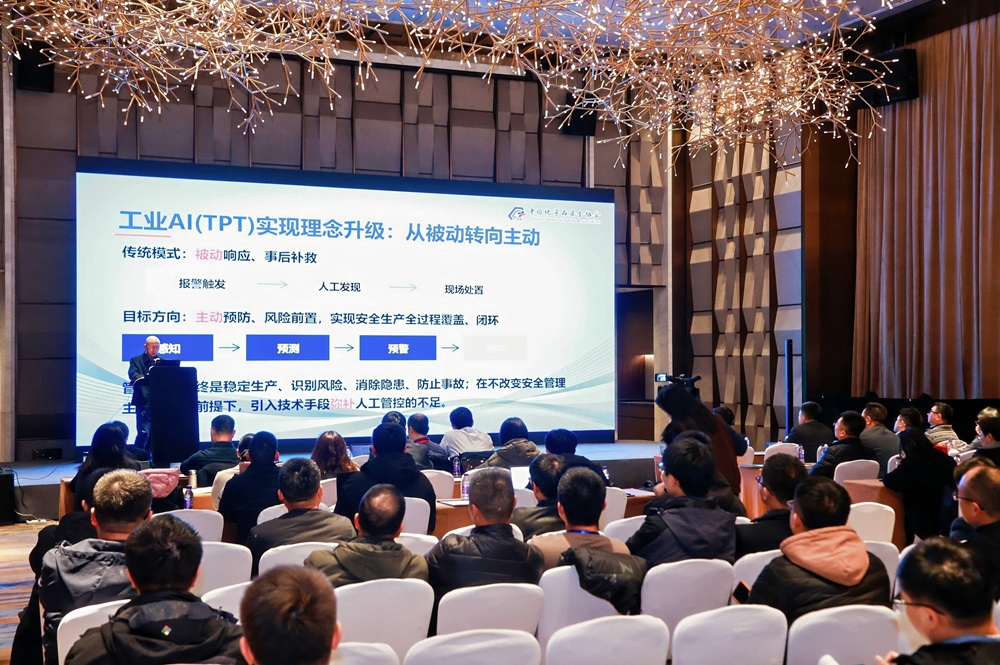
In chemical production operations, human uncertainty is an important cause of accidents. Wu Jiaxin, an expert from Supcon Technology Co., Ltd., introduced that by building an autonomous industrial AI system adapted to chemical scenarios, with a time-series large model as the foundation, it is possible to predict key factors of abnormal working conditions such as process parameters, control loops, instrument measurements, and equipment degradation in advance. This can improve the stability of the control system, enhance the reliability of equipment management decisions, move the threshold for discovering and handling abnormal conditions forward, liberate people from screen-watching and repetitive operations, and thereby reduce safety problems caused by human error.
"When artificial intelligence deeply integrates with the process experience accumulated by the factory over the long term, it will gradually change the working state of chemical practitioners who are constantly treading on thin ice and busy with transactional handling, and promote the transformation of post personnel into decision-makers for risk control," said Su Deliang, General Manager of Hangzhou Haifan Technology Co., Ltd.
The sharing by Li Yonggang, Chief Engineer of Hubei Xingfa Group, at the meeting also confirmed this viewpoint. "Artificial intelligence does not mean replacing operators to ignore alarms, but helping frontline personnel to be liberated from massive repetitive alarms, invalid alarms, and complicated daily affairs, and transforming accumulated operational experience into standard, actionable, and visualized standardized operating procedures." Li Yonggang introduced that Xingfa Group used AI-assisted means to optimize alarm management, significantly reducing invalid alarms, and the frequency of related operations dropped by 90%.
However, Su Deliang also reminded enterprises that there is a significant threshold for general large models to be directly implemented in industrial scenarios. Chemical production has extremely strong professional requirements for process linkage relationships, and it is necessary to accurately judge the chain effects of local process parameter changes on upstream and downstream processes. The core work of enterprises and technology service providers is to bridge the connection between equipment, process mechanisms, and artificial intelligence, so that AI can truly fit the actual working conditions of the factory and serve on-site safety production.