Events
China Chemical Safety Association Holds Publicity Meeting on Standards for Special Operations and Maintenance & Repair Work
On September 10, the China Chemical Safety Association (CCSA) held a meeting on standards interpretation and implementation during the 2026 China International Emergency Management Exhibition. The meeting focused on three standards—the Safety Specification for Special Operations in Hazardous Chemical Enterprises (GB 30871—2022), the Safety Specification for Equipment Maintenance Operations in Chemical Enterprises (AQ 3026—2026), and the Guidelines for the Implementation of Energy Isolation in Chemical Enterprises (T/CCSAS 013—2022)—and shared key points for risk control in inspection and maintenance operations at chemical enterprises.
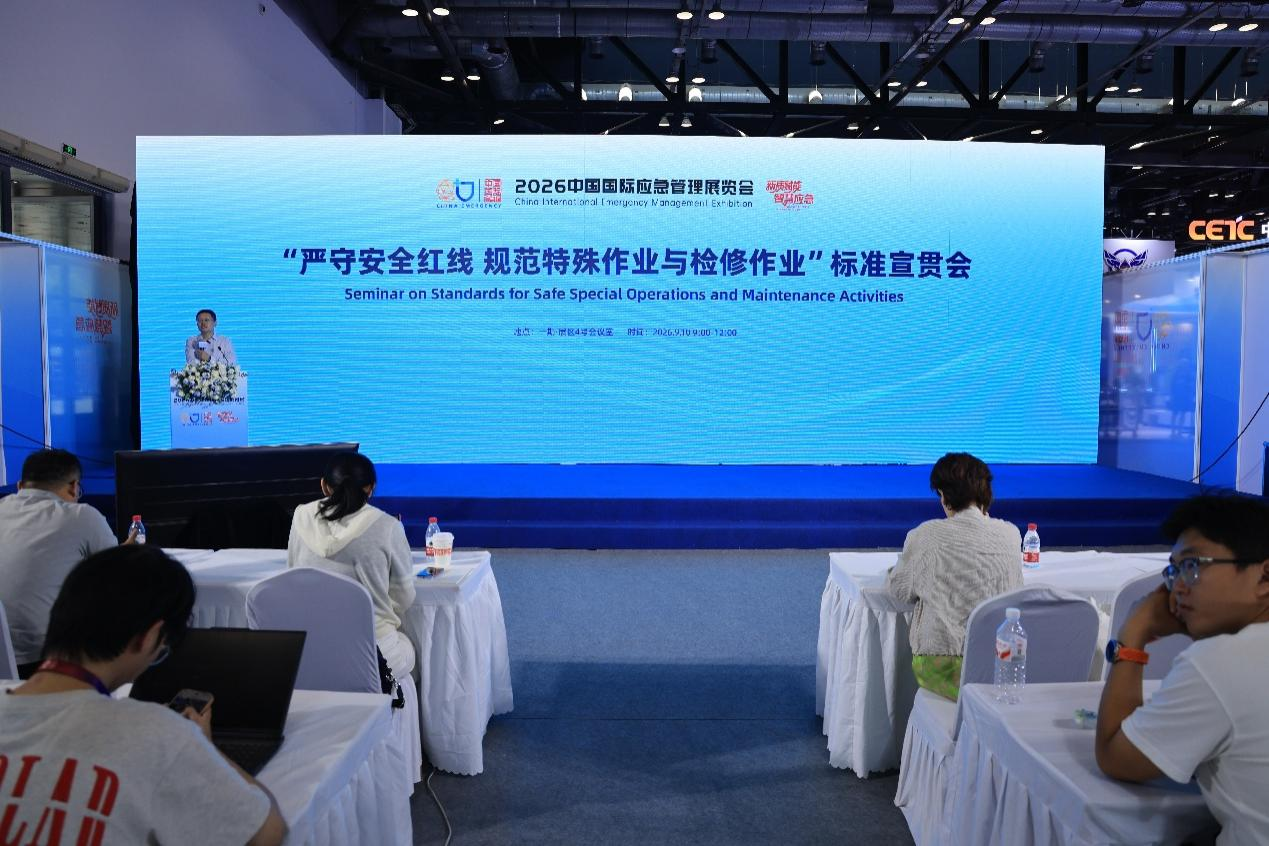
The meeting noted that the current safety situation of inspection and maintenance operations in chemical enterprises is not optimistic. Lack of hazard identification, equipment handover failing to meet safety conditions, non-standard approval of work permits, and inadequate gas detection in the working environment are the main causes of inspection and maintenance accidents.
In recent years, the state has continuously improved the safety management of inspection and maintenance operations at the levels of laws, regulations, and standards. The Safety Specification for Special Operations in Hazardous Chemical Enterprises (GB 30871—2022), issued and implemented in 2022, specifies general requirements and specific operating specifications for special operations, targeting safety risk prevention and control of eight types of special operations, including hot work and confined space operations during maintenance. In March this year, the Safety Specification for Equipment Maintenance Operations in Chemical Enterprises (AQ 3026—2026), issued by the Ministry of Emergency Management, further standardized whole-process safety management of maintenance operations, improved preparation requirements before special operations, and set clear requirements for safety management during maintenance operations and acceptance and handover after completion. The two standards are interconnected and constitute a standards system for safety risk prevention and control in inspection and maintenance operations. The meeting emphasized that the requirements of the two standards should be earnestly implemented, the responsibilities of all personnel involved in maintenance should be further refined, and risks in every stage from preparation and implementation to acceptance and handover should be controllable.
As for the largest risk source in inspection and maintenance operations—various hazardous energies such as electrical, mechanical, thermal, and chemical energy—the meeting proposed that, in addition to accurately identifying hazardous energy before equipment handover and taking corresponding energy isolation measures in accordance with the relevant requirements of AQ 3026—2026, enterprises may also refer to the association standard Guidelines for the Implementation of Energy Isolation in Chemical Enterprises (T/CCSAS 013—2022), issued and implemented by the China Chemical Safety Association in January 2022. According to actual operability, different energy isolation methods can be selected. Following the five-step method of “identify and isolate – lockout/tagout – confirm – test – unlock,” the “tiger” of hazardous energy should be firmly locked in a cage to ensure operation safety.
AQ 3026—2026 will come into effect on September 30. The meeting recommended that enterprises promptly organize multi-level training and urge relevant personnel to proficiently master the standard requirements; conduct compliance audits in accordance with the two standards and improve relevant systems such as equipment maintenance and special operations management; further standardize the work approval process and strengthen the safety execution capabilities of approval personnel at all levels and operating personnel; at the same time, strengthen equipment integrity management, reduce the probability of equipment failure and the frequency of maintenance operations, and fundamentally control maintenance operation risks.